By Abhijeet
“Truth is often forgotten. And when forgotten, it turns into a story. That story becomes a legend. And if it survives time, it becomes a myth.”
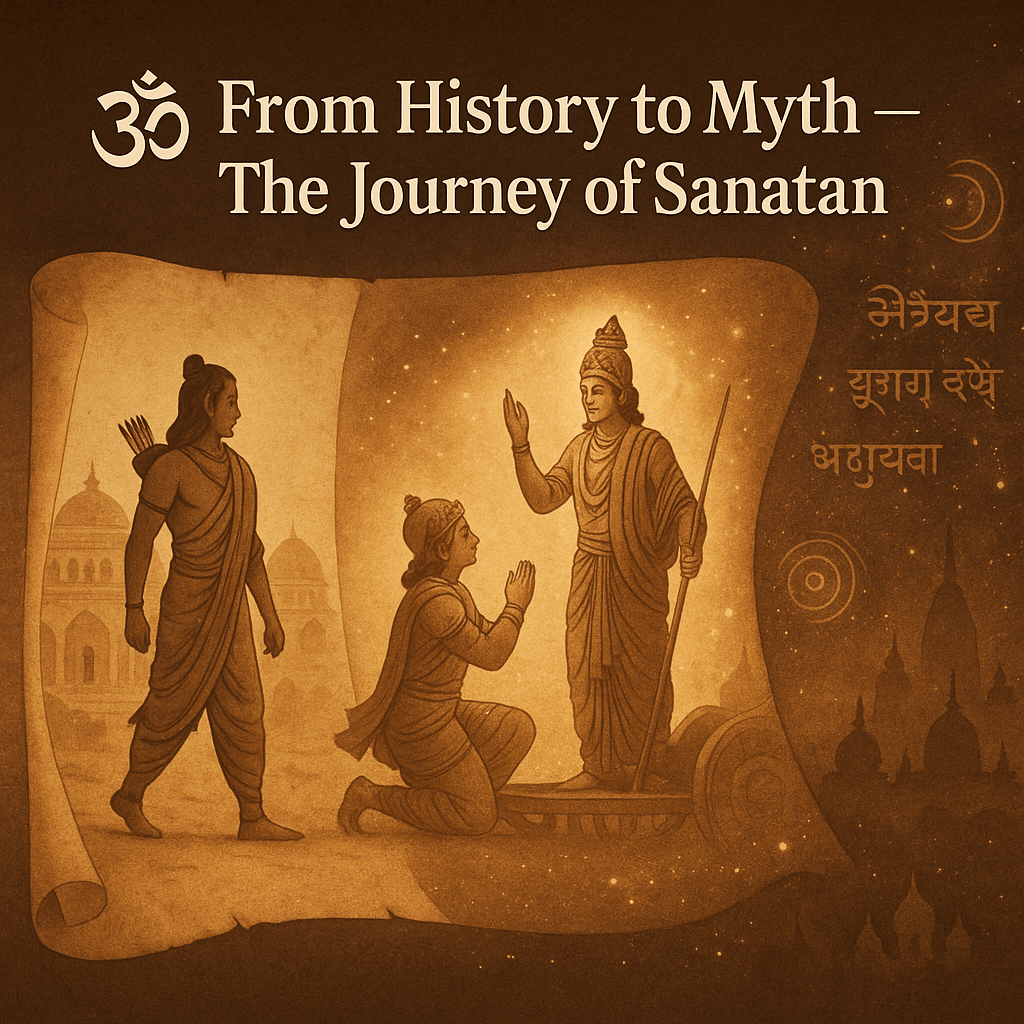
I often sit and wonder how stories from our ancient Indian past—stories that once breathed with living people, kings, saints, battles, and philosophies—have slowly been pushed into the corners of our memory as myths.
But what if those myths were once truths? What if history isn’t just written in stone but also in hearts, rituals, temples, and oral stories passed down by generations?
In this blog, I want to walk you through this fading line between history, legend, and myth, using our very own Sanatan history as the lens. Not with heavy academic jargon, but from my simple, curious perspective—as someone trying to make sense of our roots in this modern digital
The Cycle: From History to Legend to Myth
Every civilization has stories. But the unique thing about India—Bharat—is that our stories are more than entertainment. They’re layered, symbolic, and often reflect real people, real events, and real truths, passed down through oral traditions, folk songs, and epics like the Ramayana and Mahabharata.
But as time moved forward, these stories started being labeled as “mythology” instead of “history.”
Let’s understand this cycle:
- History – Real events, people, and timelines. Tangible and documented.
- Legend – Based on real events but told with emotion, symbolism, or exaggeration.
- Myth – Timeless story often seen as fiction or divine allegory.
The line between the three is not fixed, and that’s where the beauty and confusion both live.
🛕 Sanatan Examples: Were They Just Stories?
Let’s take a few well-known examples. You decide for yourself—myth or forgotten history?
1. Ramayana: A Journey Beyond Time
- Was Ram a real king?
Valmiki wrote the Ramayana not as a fantasy tale, but as a historical account. Ayodhya, where Shri Ram was born, exists. So does the route to Lanka (Rama Setu), visible through satellite imagery. - So what happened?
Over generations, as oral traditions passed on, the characters became larger than life, infused with divine energy. Scholars began treating them as myths. The history faded, the emotion stayed.
“Ram wasn’t just a character. He was the idea of Dharma in human form.”
2. Mahabharata: War or Allegory?
- The Kurukshetra war has references in archaeological studies and has been dated by astronomical positions mentioned in the epic.
- Places like Hastinapur and Indraprastha are real.
- But today, many children learn Mahabharata as fiction rather than reality.
What if Krishna was not just a flute-playing god, but also a brilliant strategist, political genius, and a master of Dharma diplomacy?
3. The Science in Sanatan Dharma
You’ll be surprised how advanced our ancestors were. Some examples:
- The Vedas speak of the speed of light.
- Concepts like reincarnation, chakras, and cosmic time (Yugas) are now being explored by quantum physicists.
- Ayurveda and Yoga, once dismissed, are now globally respected.
But all these were science-based systems, not blind faith. Yet, they’re often thrown into the “myth” category just because they’re ancient.
Why Does It Matter Today?
You might wonder—why should we care?
Because our identity, our values, and even our spiritual direction come from knowing our past.
And when our true stories get dismissed as myths, we begin to feel lost.
We start admiring other cultures and histories while forgetting that our own civilization was thriving when others were just beginning.
“A rootless tree cannot grow. And a rootless generation can’t thrive.”
Why Is Sanatan Dharma Still Alive?
Despite invasions, colonization, and western ridicule, Sanatan Dharma still stands. Why?
- It’s not just a religion. It’s a way of living.
- It doesn’t force; it invites you to experience.
- It evolves. It adapts. It’s not dogmatic.
Even Gen-Z today is rediscovering Sanatan through Yoga, Sanskrit tattoos, Bhagavad Gita reels, and meditation apps.
But the challenge is this: Are we truly understanding it, or just consuming it like trends?
From Colonizers to Classrooms: How the ‘Myth’ Label Spread
British and other western historians found it hard to accept a civilization older and more complex than theirs. So they labeled our epics and beliefs as “mythology”.
That’s how, in our schools:
- Ram becomes a ‘mythological character’
- Krishna is just a ‘blue-skinned flute player’
- Gita is seen as a religious book, not a guide for life
But think—how can a “myth” teach you about karma, leadership, duty, war strategy, ethics, and psychology all at once?
Today’s Youth: Reconnecting or Scrolling Away?
In the age of Instagram reels and AI, it’s easy to scroll past our roots. But I see a silent revolution happening:
- People are visiting Kedarnath, Sarnath, Hampi—not just for photos, but for meaning.
- Sanskrit quotes are trending.
- Gita is being read by entrepreneurs and coders.
Still, many of us are trapped in thinking:
“Sanatan is for old people,”
or “All this is mythology, bro!”
But remember—just because the West doesn’t understand something doesn’t mean it’s false.
What Needs to Change?
Here’s what I feel strongly about:
- Our education system needs to differentiate between faith, philosophy, and history.
- We should not shy away from scientific exploration of our past.
- Youth should ask questions but not mock what they don’t understand.
- We need to stop calling everything “myth” and start asking—could this have been true?
Final Thoughts from Abhijeet
I’m not a historian or a spiritual guru. I’m just someone trying to understand the deep stories we’ve grown up with. Some of them feel more real than the so-called “facts” we learn in school.
If we don’t reclaim our stories, others will rewrite them for us.
And they’ll sell our wisdom back to us—wrapped in foreign labels and expensive courses.
Let’s not let that happen.
Let’s rediscover the wisdom of Sanatan, not just in temples and rituals, but in thoughts, conversations, and everyday life.
Do you believe Ram and Krishna really existed?
Do you feel our “myths” are more than just stories?
Let’s talk. Let’s question. Let’s connect.
 Abhijeet's Blog
Leave a comment