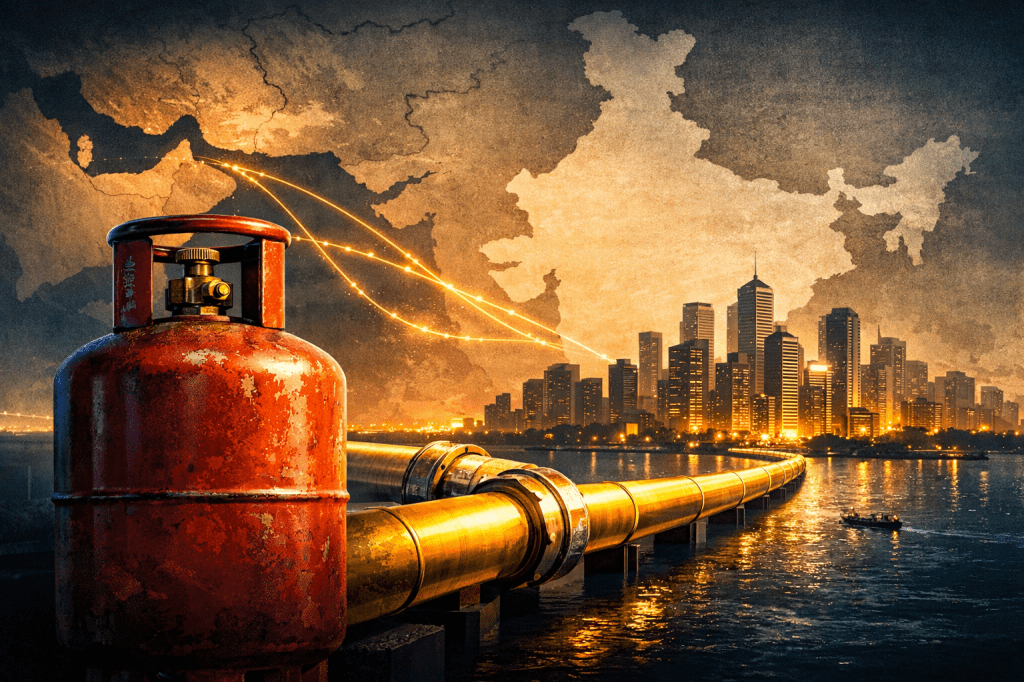
India has introduced a new rule that could change how cooking fuel is distributed across urban households.
By – Abhijeet
The Ministry of Petroleum and Natural Gas has directed oil marketing companies to stop issuing domestic LPG cylinders to consumers who already have Piped Natural Gas (PNG) connections.
Under the new directive, households with active PNG supply will not be eligible to keep or refill LPG cylinders. If a home currently uses both systems, the LPG connection will need to be surrendered.
Officials say the aim is to prioritise cylinder supply for households that depend entirely on LPG for cooking.
What the New LPG Rule Says
The order effectively prevents households from maintaining two parallel cooking fuel systems.
According to the directive:
- Consumers with PNG connections will not receive LPG cylinder refills
- No new LPG connections will be issued to homes with piped gas supply
- Existing LPG connections in such homes may need to be surrendered
Oil companies have been instructed to enforce the rule as part of revised LPG distribution guidelines.
The policy mainly affects urban areas where city gas networks have expanded rapidly over the past decade.
Why the Government Is Prioritising LPG Supply
India’s demand for cooking gas has grown significantly in recent years.
Government programs expanded LPG access to millions of households, particularly through initiatives such as the Pradhan Mantri Ujjwala Yojana, which aimed to replace traditional cooking fuels with cleaner gas cylinders.
At the same time, pipeline gas networks have expanded across major cities. Millions of households now receive PNG directly through pipelines.
Allowing households to maintain both PNG and LPG systems increases pressure on the country’s LPG distribution network. By restricting cylinders for PNG users, policymakers aim to ensure that LPG reaches homes without access to piped gas infrastructure.
India’s Dependence on Imported LPG
Another factor shaping the policy is India’s dependence on imported energy.
A large portion of the LPG used in Indian kitchens is imported from producers in the Gulf region. Much of this supply travels through the Strait of Hormuz, one of the most important energy shipping routes in the world.
Any disruption in this corridor can quickly affect global fuel supply chains and shipping costs.
Recent tensions in West Asia have drawn attention to the vulnerability of energy routes that many importing countries rely on.
While the government has not directly linked the new LPG rule to these geopolitical developments, the situation highlights why managing domestic fuel distribution remains important for energy security.
Impact on Urban Households
The immediate impact of the rule will be felt in cities where PNG infrastructure has expanded rapidly.
In metropolitan regions such as Delhi, Mumbai, Ahmedabad and Pune, many households adopted PNG for daily cooking but continued to keep LPG cylinders as backup fuel.
The new directive means such households may have to rely entirely on pipeline gas supply instead of maintaining both options.
For consumers without PNG access, however, LPG cylinders will remain the primary cooking fuel.
A Changing Cooking Energy Landscape
India’s cooking fuel ecosystem is gradually evolving.
LPG cylinders expanded clean cooking access across rural and semi-urban regions, while pipeline gas networks are transforming urban energy distribution.
At the same time, electric cooking appliances are slowly entering the market as an alternative option in some households.
The new LPG rule signals a clearer division between these systems. Pipeline gas will increasingly serve urban areas, while LPG cylinders will be prioritised for households that have no access to PNG infrastructure.
The Bigger Energy Security Question
Energy policy decisions are rarely shaped by domestic factors alone.
Global supply routes, geopolitical tensions and rising demand all influence how countries manage their fuel systems.
India’s decision to restrict LPG cylinders for PNG users reflects a broader effort to streamline domestic energy distribution while maintaining supply stability.
As the world’s energy markets remain uncertain, the connection between global fuel routes and everyday household energy use is becoming more visible than ever.
 Abhijeet's Blog
Leave a comment