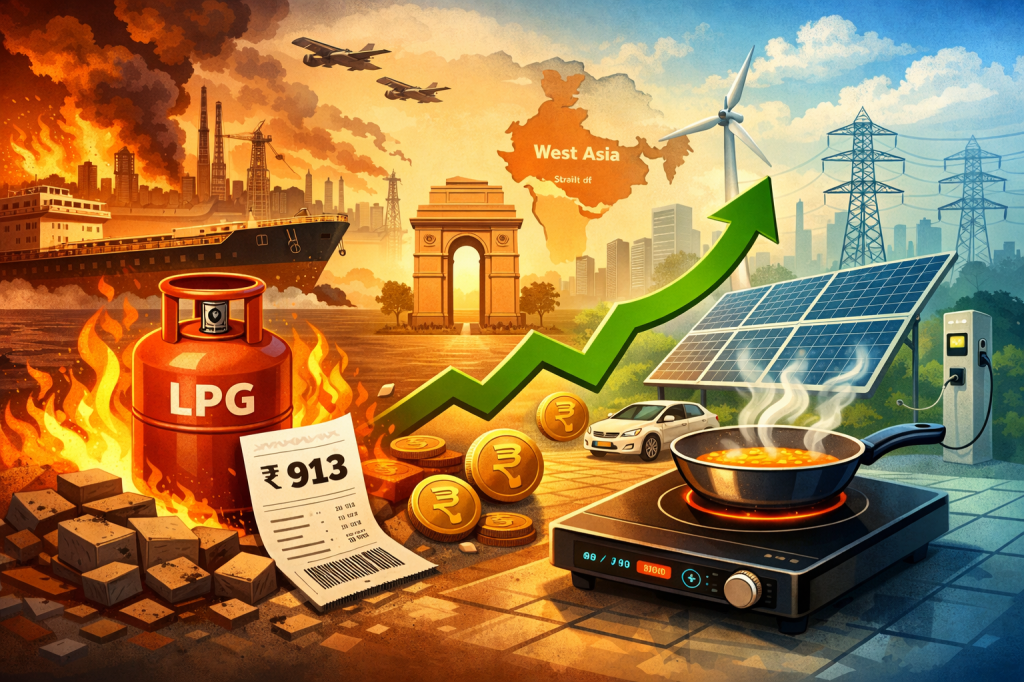
Rising tensions in West Asia are exposing India’s dependence on imported cooking gas. The disruption risk is pushing households to rethink energy choices and investors to look closely at India’s electrification story.
By – Abhijeet
For many Indian households, global conflicts rarely feel personal. Wars happen far away, markets fluctuate somewhere else, and geopolitics feels like a distant conversation.
But when the price of a cooking gas cylinder rises or supply becomes uncertain, the impact arrives directly in the kitchen.
The recent escalation of tensions in West Asia has reminded India of an uncomfortable reality. A large share of the cooking fuel used in Indian homes travels thousands of kilometres before reaching local gas agencies. Any disruption along that route can quickly affect domestic supply and prices.
India’s dependence on imported LPG
India is one of the world’s largest consumers of liquefied petroleum gas. Over the past decade, LPG demand has surged as millions of households shifted to cleaner cooking fuels.
However, domestic production has not kept pace with this growth.
According to data from the Petroleum Planning and Analysis Cell, India produced about 1.15 million tonnes of LPG in January 2026 while imports stood at roughly 2.19 million tonnes.
In other words, imports now meet around 60 to 65 percent of India’s LPG demand.
Most of these imports come from West Asia and pass through the Strait of Hormuz, one of the most important energy shipping routes in the world.
That is why any tension in the region quickly raises concerns about India’s cooking fuel supply.
Recent reports suggest LPG arrivals in India have declined sharply as tanker traffic through the region slowed, highlighting the vulnerability of global energy supply chains.
Why households are feeling the pressure
The impact is not only about supply disruption. Price volatility is also becoming more visible for consumers.
India now has more than 320 million LPG connections, with households accounting for nearly 90 percent of total LPG consumption.
This means even small changes in global LPG prices can affect millions of families.
For a middle class household, the LPG cylinder is not just another utility expense. It is a basic necessity that influences the monthly budget.
When global energy markets become unstable, the financial stress quickly filters down to everyday household spending.
The quiet shift toward electric kitchens
At the same time, a gradual change is taking place in urban Indian kitchens.
Induction cooktops and electric cooking appliances are becoming more common, especially in cities where electricity supply has improved significantly over the past decade.
Several factors are driving this shift.
Electric cooking appliances are relatively inexpensive and easy to install. They offer quick heating and better temperature control. More importantly, electricity prices tend to be more stable compared with globally traded fuels such as LPG.
The growing adoption of rooftop solar installations in urban homes is also encouraging households to experiment with electric cooking.
For many families, induction cooktops are no longer emergency backup devices. They are becoming a regular part of the kitchen.
The investment angle
Energy transitions usually happen slowly, but geopolitical shocks often accelerate existing trends.
The current uncertainty in global fuel markets has renewed investor interest in sectors linked to domestic energy generation.
Companies involved in renewable energy and power infrastructure such as NTPC, Tata Power and JSW Energy are expanding capacity in solar, wind and grid infrastructure.
As India increases electricity generation from domestic renewable sources, the role of electricity in everyday energy consumption is likely to grow.
For investors, the larger theme is not the short term price movement in LPG but the long term electrification of the economy.
India’s push for energy resilience
India has already begun building policies aimed at reducing reliance on imported fossil fuels.
Renewable energy expansion, large scale solar installations and initiatives such as the National Green Hydrogen Mission are part of a broader strategy to strengthen domestic energy security.
The logic is straightforward. If more energy needs are met through electricity generated within the country, global supply disruptions will have a smaller impact on households and businesses.
This transition will take time, but the direction of change is becoming clearer.
Remember the words
The LPG cylinder has been at the centre of the modern Indian kitchen for decades. It replaced traditional fuels and transformed household cooking across the country.
Yet energy systems evolve with technology, economics and geopolitics.
The current tensions in West Asia may eventually ease, and LPG supplies may stabilise again. But the episode has highlighted how deeply global energy markets influence everyday life in India.
For households, the lesson is about diversifying energy choices. For investors, it is about recognising the structural shift toward electrification and domestic energy sources.
The kitchen may not seem like the front line of global geopolitics. But as the recent energy shock shows, the path from the Strait of Hormuz to the Indian household is shorter than it appears.
 Abhijeet's Blog
Leave a comment