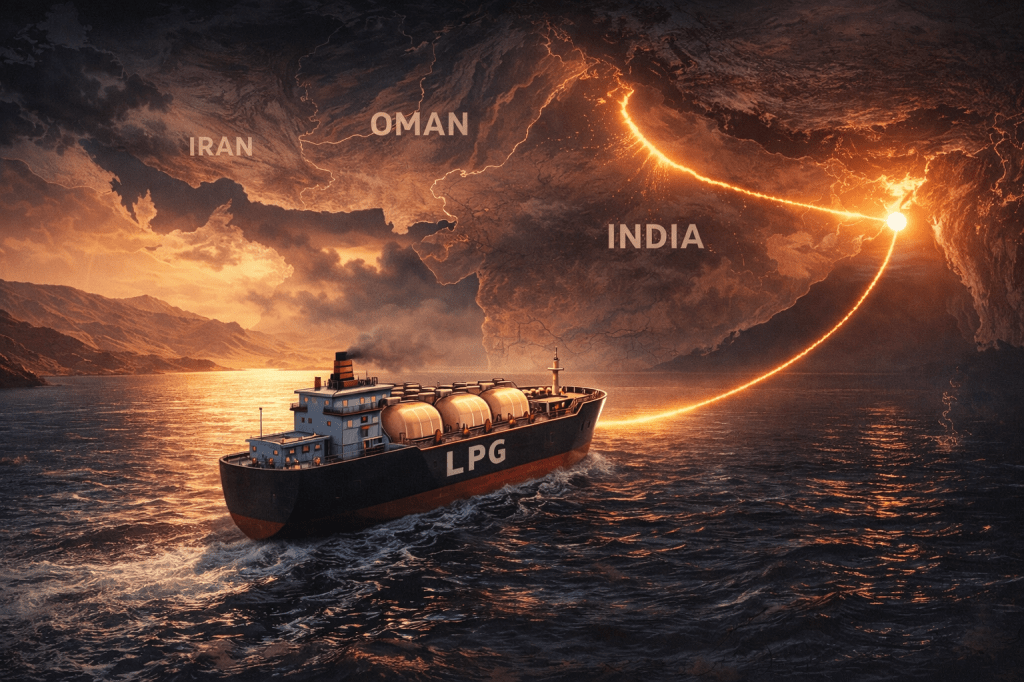
For the past 24 hours, a viral claim has been circulating across social media and messaging platforms. Many posts say that the Strait of Hormuz has reopened for India’s oil and gas trade.
By – Abhijeet
The reality is more complicated.
The route has not fully reopened. Iran has only allowed a limited number of India-bound LPG carriers to pass through the strait. Several vessels are still waiting for clearance, and shipping activity remains restricted.
Understanding this difference is important because the Strait of Hormuz is one of the most critical energy corridors in the world.
Why the Strait of Hormuz matters to India
The narrow waterway between the Persian Gulf and the Gulf of Oman carries a large share of the world’s energy trade. Nearly one fifth of global oil shipments move through this corridor every day.
For India, the route is even more crucial.
India imports more than 80 percent of its crude oil needs. A large share of its liquefied petroleum gas also comes from producers in the Gulf region. Millions of Indian households depend on LPG cylinders for cooking, which makes supply stability a political and economic priority.
Any disruption in the strait can quickly affect shipping schedules, global prices, and domestic fuel planning.
What actually happened in the latest development
Recent geopolitical tensions in West Asia created uncertainty around maritime traffic in the region. Shipping companies became cautious, and several vessels slowed their movement or waited for clearance before entering the strait.
Amid this uncertainty, Iran allowed a small number of LPG carriers heading to India to pass through the route.
Reports indicate that at least two India-bound LPG tankers were given permission to transit the strait. However, many other vessels linked to Indian cargo are still waiting for safe passage.
This means the route is operating under selective permissions, not normal commercial traffic.
Why the viral claim is misleading
The viral message claiming that the Hormuz route has opened for India suggests a full restoration of energy flows.
That is not the case.
Shipping activity in the Strait of Hormuz remains sensitive because of tensions involving regional and global powers, including United States and Israel.
The limited passage granted to a few Indian ships should be seen as a controlled decision rather than a reopening of the maritime corridor.
Energy analysts describe the situation as a temporary operational adjustment rather than a strategic shift.
Why Iran may have allowed Indian vessels
Allowing selected ships to move through the strait may serve several diplomatic and economic purposes.
First, Iran has an interest in showing that it is not disrupting global energy markets completely. A full blockade would raise international pressure and increase the risk of escalation.
Second, India is one of the largest energy consumers in Asia and maintains working relationships with multiple countries in the region. Granting limited passage to Indian ships allows Tehran to signal flexibility without surrendering strategic leverage.
Third, the global oil market reacts strongly to any disruption in the strait. Even a perception of blockade can push prices higher. Allowing selective movement helps reduce panic in energy markets.
What this means for India’s energy security
The situation highlights how vulnerable global energy supply chains remain to geopolitical shocks.
For India, dependence on maritime routes through the Strait of Hormuz creates a structural risk. Any prolonged disruption could delay LPG shipments, increase transportation costs, and add pressure on domestic energy subsidies.
It also reinforces the long-term argument for diversifying energy sources. Investments in renewable power, electric cooking technologies, and domestic infrastructure are increasingly seen not only as climate policies but also as strategic energy decisions.
The words worthy
The viral claim that the Hormuz route has fully opened for India’s oil and gas trade is inaccurate.
Iran has only allowed a small number of India-bound LPG carriers to pass through the strait so far. Several vessels remain delayed, and shipping activity in the region is still operating under heightened caution.
In other words, the world’s most important energy chokepoint is not closed. But it is far from normal.

 Abhijeet's Blog
Leave a comment